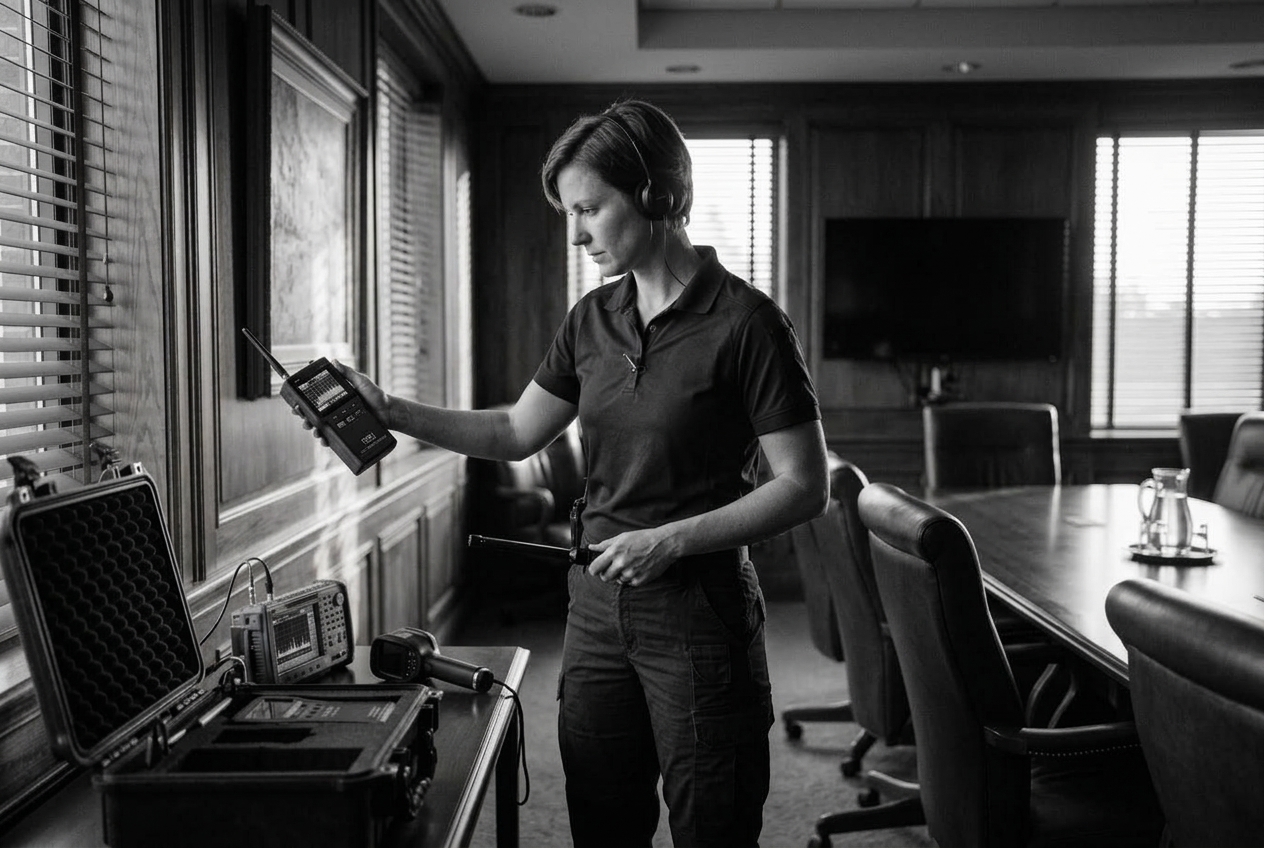
The Other End of the Bug:
Why Finding a Surveillance Device Is Not the End of a TSCM Survey
By Verrimus / TSCM Training
There is a phrase used throughout the commercial Technical Surveillance Counter-Measures (TSCM) industry that we have never particularly liked: “Bug sweep.” It is catchy. It is understandable. It is also, in our view, an unfortunate description of what a properly conducted TSCM operation is actually supposed to achieve.
We have previously explained why we dislike the terminology in our article, Bug Sweep Services. The problem is not simply one of language. The terminology can influence how people think about the task.
If you believe your job is to find bugs, then finding a device can very easily become the point at which you believe the job is finished. It isn’t. A TSCM survey should be about much more than finding an interesting-looking box hidden beneath a table.
The real question is:
What does the discovery tell us about the compromise of privacy?
And that leads us to a much more important question:
What is at the other end of the bug?
Finding something is only the beginning
Let’s consider the Hollywood version of technical surveillance.
A TSCM operator enters a boardroom, conducts a sweep and discovers the mythical black box attached to the underside of the boardroom table.
Excellent.
It has been found. Photographs are taken. The device is removed. A report is produced stating that a technical surveillance device was located. Job done? Not even close. The discovery should immediately generate a series of questions.
What is the device?
What is it capable of doing?
Is it transmitting? Recording? Both?
How is it powered?
How does it communicate?
How long could it have been operational?
When might it have been installed?
How could it have been installed without detection?
Who had the opportunity to install it?
Who might have commissioned the installation?
What information could it have collected?
Who could potentially have received that information?
And, perhaps most importantly:
What does this tell us about the wider security of the environment?
Finding the device is evidence.
Understanding the device, its likely deployment, its capability and its context is what starts to turn that evidence into an assessment of the compromise.
Think beyond the device
One of the fundamental principles that should underpin professional TSCM work is that the technical surveillance device is not necessarily the threat.
It is a means of achieving the threat actor’s objective.
The device is simply one component in a much larger chain.
At TSCM Training, we encourage practitioners to think beyond the physical object they have discovered.
Consider a simple conceptual chain:
Threat actor → objective → opportunity → surveillance method → technical capability → information collected → recipient
The device sits somewhere in the middle.
It is not the beginning.
And it certainly isn’t the end.
If a surveillance device has been deployed into a boardroom, the important issue isn’t merely that a device was found beneath the table.
The important issue is what information may have travelled through that device, who wanted that information, and what they intended to do with it.
That changes the nature of the TSCM operation.
It becomes an investigation into a privacy compromise, rather than simply a search for equipment.
Who is at the other end?
This is a question that we believe commercial TSCM practitioners should be asking themselves far more often.
Who could be at the other end of the privacy compromise?
It may be a competitor.
It may be a criminal organisation.
It may be an insider.
It may be someone involved in a dispute.
It may be an unknown third party.
The identity may not be immediately discoverable.
But that doesn’t mean the question shouldn’t be asked.
Understanding the potential threat actor can help inform the assessment of what has been discovered.
If, for example, the organisation is involved in a particularly sensitive negotiation, litigation, acquisition, political matter or commercially significant transaction, the timing of a surveillance attack may be highly significant.
The TSCM operator doesn’t necessarily need to become an investigator or intelligence analyst.
But they should understand enough about the context of the survey to recognise that technical surveillance doesn’t happen in a vacuum.
What are they hoping to hear or see?
This is the second question.
If somebody has gone to the trouble of deploying technical surveillance, there is presumably something they want.
What is it?
Boardroom conversations?
Commercial negotiations?
Strategic plans?
Legal discussions?
Personal information?
Security procedures?
Credentials?
Customer information?
Something else entirely?
The answer matters.
It can influence how the significance of a discovery is assessed.
A surveillance device located in an office where nothing particularly sensitive is discussed is one thing.
A device located in a room where commercially critical negotiations have taken place for the previous six months is something else.
The physical discovery may be identical.
The security significance is not.
When was it deployed?
Timing matters.
A surveillance attack doesn’t necessarily need to have been installed yesterday to be relevant today.
Perhaps the device has been present for months.
Perhaps it was installed immediately before a significant meeting.
Perhaps it was deployed following a change in circumstances.
Perhaps the organisation has recently entered negotiations with a competitor.
Perhaps there is a political development.
Perhaps there is a legal dispute.
Perhaps a former employee has left.
Perhaps something valuable has changed.
The question isn’t simply:
“When did we find it?”
The question should also be:
“When could this have been placed here, and what was happening at that time?”
That distinction can completely change the interpretation of the discovery.
Where is the technical team?
This is another area where we believe TSCM practitioners need to think beyond the immediate physical search.
If there is reason to believe that a technical surveillance attack may be present, the possibility exists that someone, somewhere, may currently be monitoring the environment.
That means that the TSCM operation itself may be taking place inside the compromised environment.
Think about that for a moment.
If someone is listening to a room remotely, why would we want to make their job easier?
Why would we announce what we are doing?
Why would we identify the equipment we are using?
Why would we unnecessarily disclose our methods?
Why would we create an obvious indication that a TSCM team is present?
There may be legitimate circumstances where visibility is intentional.
A clearly identifiable TSCM presence can, for example, be used as a deterrent.
But deterrence is a conscious operational decision.
It should not simply be the accidental consequence of poor operational discipline.
“Pass me the NLJD…”
We’ve seen examples of TSCM teams openly discussing their equipment while operating within an area of concern.
“Pass me the NLJD.”
“Where’s the directional antenna?”
“Get the detector.”
Perhaps these comments appear harmless.
They aren’t necessarily harmless.
If you suspect that the area may contain a technical surveillance attack, you have to consider the possibility that somebody else may be listening.
Why provide that person with information about what you are doing?
We are deliberately not going to turn this article into a list of TSCM operational TTPs.
There is a difference between educating practitioners and publishing an operational playbook.
But the underlying principle is straightforward:
If you suspect that someone may be watching or listening, behave accordingly.
Operational security isn’t something that begins after you find a device.
It should be part of the TSCM operation from the outset.
And what about the “bug sweeper” uniform?
We have also seen commercial TSCM teams arriving at sites wearing highly branded clothing that effectively announces:
WE ARE HERE TO SWEEP FOR BUGS.
There may be circumstances where that is entirely appropriate.
If the purpose of the operation is overt deterrence, a visible TSCM presence can have value.
But if the objective is to conduct a discreet technical surveillance assessment, we would question the operational logic.
Why advertise to everyone in the vicinity what you have been brought in to do?
Why potentially alert somebody who may have deployed a surveillance capability?
Why create an unnecessary signature?
The point isn’t that branded clothing is inherently wrong.
The point is that the operational requirement should determine the approach.
TSCM is not theatre.
It is a security activity.
The difference between a search and a TSCM operation
This is where we believe training matters.
A person can learn how to operate sophisticated detection equipment.
That doesn’t necessarily mean they understand TSCM.
A person can learn how to identify a signal.
That doesn’t necessarily mean they understand the significance of that signal.
A person can locate a suspicious device.
That doesn’t necessarily mean they understand the compromise represented by its presence.
And a person can produce a beautifully presented report listing equipment and measurements while completely missing the bigger picture.
Equipment competence and TSCM competence are not the same thing.
Good TSCM practitioners need to understand the technology, but they also need to understand threat, context, behaviour, opportunity and consequence.
The technology is the means.
The privacy of the client is the thing we are trying to protect.
Don’t just find the bug. Understand the attack.
Imagine two TSCM reports.
The first says:
“One covert technical surveillance device located beneath the boardroom table.”
The second says:
“A covert technical surveillance capability was identified within the area of concern. Assessment of the device indicates that it may have provided a means of collecting information from conversations occurring within the room. Consideration has been given to its likely deployment window, installation opportunity, potential operational capability and the nature of information that may have been accessible during that period.”
Those two reports may relate to exactly the same physical discovery.
But they demonstrate very different levels of thinking.
The first tells the client:
We found a thing.
The second starts to tell the client:
You may have experienced a compromise.
That distinction is fundamental.
TSCM is about privacy, not trophies
There is sometimes an unfortunate culture within the industry where finding a device becomes a badge of honour.
A photograph of a hidden transmitter.
A suspicious cable.
A modified piece of equipment.
A discovery that makes for a good story.
We understand the appeal.
But the objective of a TSCM survey isn’t to come home with a trophy.
It is to provide the client with an informed assessment of their exposure to technical surveillance.
Sometimes that means finding nothing.
And a competent TSCM operation that finds nothing is not necessarily a failure.
Equally, finding something isn’t necessarily a success.
The quality of the operation lies in what the practitioner understands and communicates about the environment and its potential compromise.
Think like the person who deployed it
Perhaps the most useful mental exercise for a TSCM practitioner is deceptively simple:
Put yourself on the other side of the problem.
If you wanted to obtain information from this environment:
- Why this location?
- Why this room?
- Why now?
- What information would you want?
- How would you expect to obtain it?
- What opportunities might exist?
- What would you need to know about the environment?
- What would you need to know about the people using it?
- What would make the surveillance worthwhile?
You don’t need to become a hostile intelligence operative to ask those questions.
You need to understand that the technical surveillance attack exists because someone has an objective.
The device is merely part of the mechanism.
Who. What. Where. Why.
Perhaps this can be reduced to four questions:
WHO?
Who might be responsible?
Who might benefit?
Who could have had access?
Who could be receiving the information?
WHAT?
What has been compromised?
What information could have been collected?
What capability did the surveillance method provide?
What else might need consideration?
WHERE?
Where was the capability deployed?
Where could the information have gone?
Where might those responsible have been operating?
Where else might similar vulnerabilities exist?
WHY?
Why was this target selected?
Why was the surveillance deployed?
Why now?
Why this particular information?
These questions won’t always have immediate answers.
They don’t have to.
The important thing is that the TSCM practitioner is thinking about them.
Raising the standard
There are many highly capable TSCM practitioners and organisations delivering excellent work.
But there is also a commercial TSCM marketplace where standards and approaches vary considerably.
Our concern is that the accessibility of detection equipment, combined with the persistent “bug sweep” mentality, can create the impression that TSCM is primarily about searching rooms until something is found.
It isn’t.
TSCM is a specialist security discipline.
It requires technical knowledge.
It requires methodology.
It requires disciplined observation.
It requires operational security.
It requires an understanding of the threat environment.
And, perhaps most importantly, it requires the ability to think beyond the equipment.
So, what is the purpose of a TSCM survey?
At its simplest, we would describe it as:
The detection, identification and location of technical surveillance attacks or methods that could have been used, deployed or modified to compromise the privacy of the area of concern.
But even that definition needs to be understood in context.
If something is detected, the job does not necessarily end with:
“We’ve found a bug.”
That may actually be where the more important questions begin.
What is it?
What could it do?
How long might it have been there?
Who could have placed it there?
What could it have collected?
Who might have wanted that information?
What was happening at the time?
What does the discovery tell us about the client’s wider exposure?
And ultimately:
What does this mean for the privacy and security of the client?
That’s the other end of the bug.
And that is where professional TSCM thinking needs to begin.
TSCM isn’t about finding bugs.
It’s about understanding compromise.
If your TSCM methodology stops when you find the device, you may have found the technology.
You may not have found the threat.